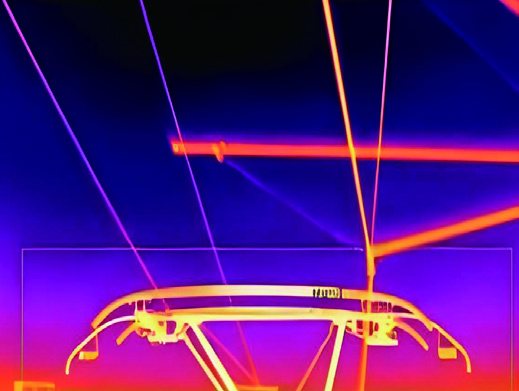
Rail systems run on electrical contact, and every contact in the chain fails the same way: resistance rises, the joint heats, and what started as a maintenance item becomes a service-stopping failure. Thermal imaging monitors the entire chain — from the pantograph sliding against the catenary at line speed, through traction substations, down to the electrical cabinets inside the train itself.
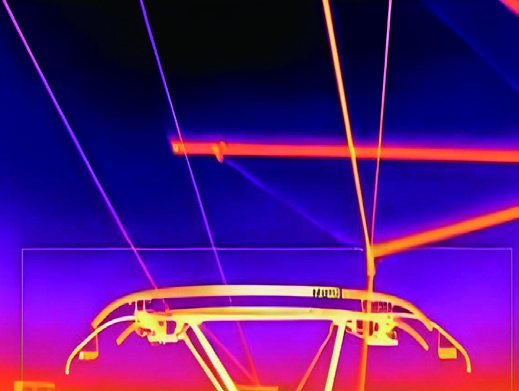
The pantograph-catenary interface is the signature application. Arcing, worn carbon strips, and poor contact pressure all show up as heat at the contact point — but the target moves at line speed, which is why wayside systems pair fast, high-sensitivity cooled cores with trackside triggers. Slower assets — transformers, cabinets, freight — are served well by uncooled LWIR cores in fixed installations.
Typical Deployments
- Wayside pantograph monitoring: trackside thermal cameras image every passing pantograph, flagging overheated contact strips, abnormal arcing signatures, and structural hot spots before a dewirement
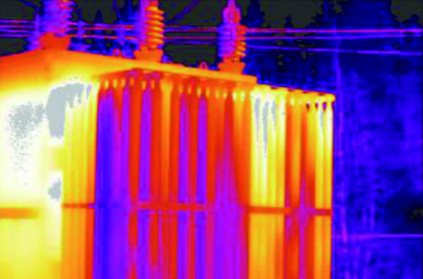
- Traction substations: transformers, rectifiers, and cable connections under continuous radiometric supervision — temperature drift between inspection cycles triggers maintenance
- On-board electrical cabinets: depot or wayside thermal checks of under-floor and roof-mounted cabinets catch failing contactors and loose terminals
- Hot box and brake detection: lineside scanners read axle box and brake disc temperatures on passing stock, a decades-proven thermal application now built with modern cores
- Freight fire prevention: coal and bulk freight monitored for self-heating during transport and staging; tunnel sections watched for hot spots after incidents
Module Selection Guide
| Scenario | Module | Key figures |
|---|---|---|
| Wayside pantograph & moving stock | SPECTRA M06A (cooled MWIR 640) | High sensitivity, fast integration times for moving targets |
| Substation & cabinet fixed monitoring | SPECTRA L06A (640×512) | Compact radiometric core, multiple lens options |
| Depot yards & wide-area coverage | SPECTRA L12NT (1280×1024) | High pixel count for large scenes per camera |