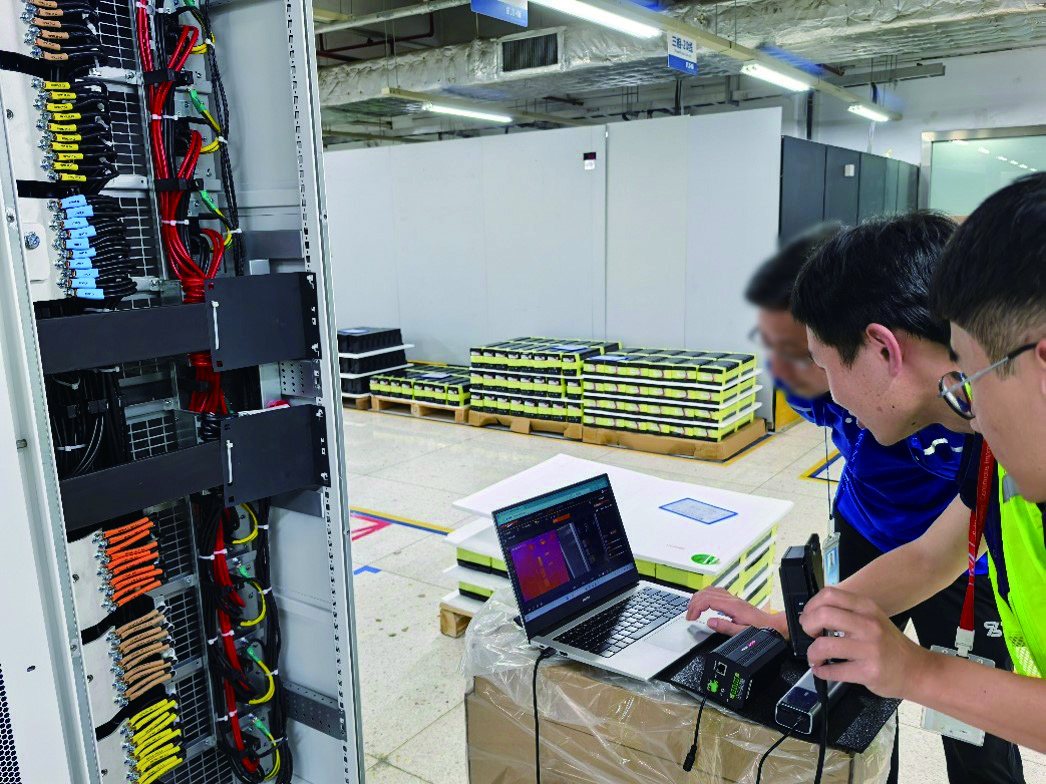
Lithium battery energy storage does not fail gracefully. A single cell entering thermal runaway vents hot gas, ignites, and can propagate through a module, a rack, and ultimately a container. Smoke and gas detectors announce the event only after venting has started — by then you have minutes. Temperature, measured at the module face, rises hours earlier. That gap is where fixed thermal monitoring earns its place.
This case looks at how a grid-side storage station added a radiometric thermal layer across its battery racks, ahead of the BMS thresholds and long before the smoke detectors.
Project Background
In 2024, a 100 MW/200 MWh grid-side storage station in East China — forty 5 MWh container units arranged in two rows — completed its first year of operation. The station cycles daily for peak shaving, and the combination of summer cabin temperatures and heavy cycling had the operator’s safety committee looking for an earlier-warning layer beyond the BMS and the container-level smoke and gas detectors. A sister station in the same provincial group had lost a container to thermal runaway the previous year — no propagation beyond it, but the review made uncomfortable reading. The operator approved a pilot covering eight containers and 96 rack aisles with fixed thermal cameras.
Pain Points of the Traditional Approach
The station’s existing protection layers all had the same weakness: they confirm a problem rather than anticipate one.
- BMS temperature sampling is sparse. Each module carries a handful of thermistors at fixed points. A cell failing between sensors can run tens of degrees hot locally before the nearest sensor registers anything, and BMS sampling intervals and averaging smooth out fast rises.
- Smoke and gas detection is late by design. Off-gas and smoke mean venting has already begun. From that point the crew has minutes, and the event is usually committed.
- Manual rounds are snapshots. A technician walking containers once a day with a handheld camera mostly photographs cabinet doors, and the gaps — nights, weekends, holidays — are exactly when faults like to develop.
- Threshold alarms are noisy. Absolute temperature alarms fight cooling faults and sensor drift, so thresholds drift upward and real anomalies hide underneath.
The Thermal Imaging Solution
The pilot installed two radiometric LWIR cameras per container, one at each end of the rack aisle, so that every module face in the container falls inside some pixel of some frame. Cameras were built around 1280×1024 radiometric cores, which put enough pixels on each module face at aisle length to resolve a single heating module.
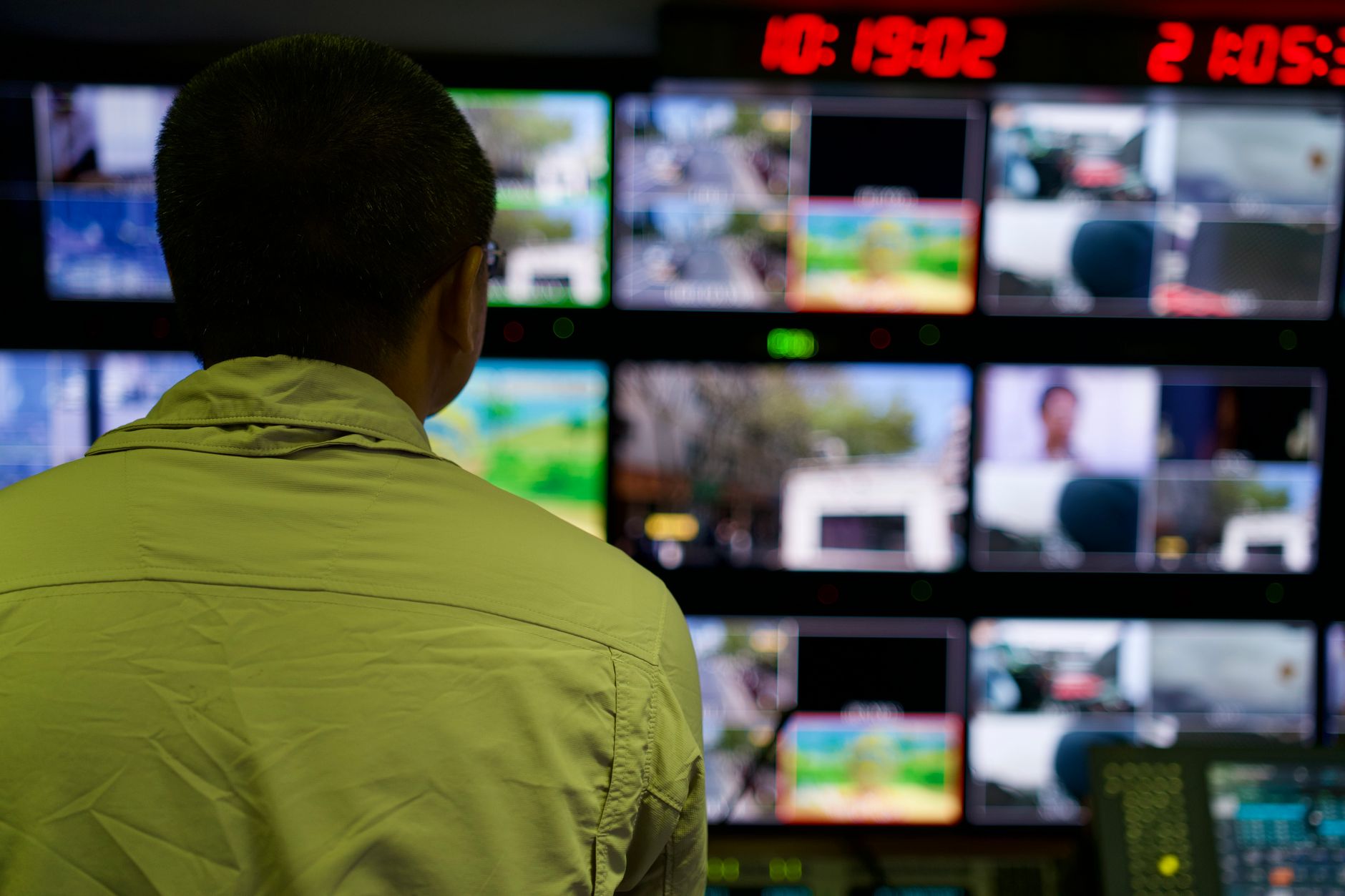
The analytics deliberately avoid absolute thresholds. The server compares each module face against its rack-mates under the same charge or discharge step — a module running 3°C above its neighbors is statistically abnormal long before it is dangerous. Three alarm tiers feed the station SCADA: an advisory at a 3°C differential, a work order at 5°C sustained for ten minutes, and an emergency sequence — container isolation, forced ventilation, crew dispatch — at 8°C or at a fast rate of rise.
What the Thermal Solution Changed
The first real catch came six weeks in: a module warming 4°C above its rack-mates during the charge step, flagged at advisory tier. Teardown found a busbar connection with rising contact resistance — a classic pre-failure signature — and the module was swapped during a planned outage. Under the old regime, that module would have announced itself as an off-gas alarm some months later.
- Lead time moved from minutes to hours. Thermal differentials catch failing cells and connections while the response is still a work order, not an emergency.
- Coverage became continuous. Every module face in the pilot containers, every minute — replacing one walk-through per day.
- Alarm quality improved. Differential comparison cancels weather and cooling noise; the station reports roughly 80% fewer temperature alarms with higher sensitivity at the same time.
- The archive became an asset. Per-rack thermal history supports the insurer’s requirements and gives the safety committee a defensible record for every rack, every day.
Module Selection Notes
Rack-aisle monitoring calls for a radiometric LWIR core with enough pixels per module face at aisle length, stable output across the cabin’s temperature swing, and an Ethernet interface the SCADA server can poll continuously. The SPECTRA L12T 1280×1024 LWIR core covers a full container aisle from one end; for shorter aisles or tighter budgets, the SPECTRA L06T2 640×512 core is the workhorse option. See the battery safety application page for related deployment patterns.
Planning thermal monitoring for a storage station or battery facility? Talk to our engineers about core selection, optics, and SCADA integration.