Every night patrol faces the same impossible trade-off. Turn on a white-light torch and you can see — but so can everyone else, and your position is announced for hundreds of meters. Work dark with image intensifiers and you keep your concealment — but a person standing still in foliage, or anything behind smoke, simply disappears. The answer is not a better torch; it is a second, independent channel that sees heat instead of light, fused with the first so the wearer gets both pictures at once.
This case looks at how a night patrol unit moved to helmet-mounted low-light and thermal fusion — and what hands-free, signature-free vision changed in the field.
Project Background
In 2024, the equipment officer of a public security patrol detachment in southern China — teams running night anti-poaching and anti-smuggling patrols through wooded hills and plantation terrain — reviewed the unit’s night equipment after an operational season that had made its limits impossible to ignore. Patrols worked with white-light torches, a handful of aging image-intensifier monoculars, and one shared hand-held thermal viewer per team. The friction was constant: torch use was tactically unacceptable on approach, the intensifiers washed out near any light source and saw nothing through foliage or smoke, and the thermal viewer — the one sensor that actually found people — occupied a hand and one team member’s full attention whenever it was in use. A night exercise that spring crystallized the problem: a four-person patrol walked past two stationary observers in tree shadow, undetected on every device they carried, at under twenty meters. The unit funded a helmet-mounted fusion trial: dual-channel low-light and thermal eyewear for a full patrol team.
Pain Points of the Traditional Approach
- White light is a beacon. Any torch use announces the patrol’s position and direction of attention, and ruins the team’s dark adaptation for minutes afterwards.
- Image intensifiers amplify light that isn’t there. Against dark backgrounds — tree shadow, unlit structures, overcast nights — intensifiers deliver noise; through smoke or foliage they deliver nothing.
- A hand-held thermal viewer is a part-time sensor. The team member using it cannot use their hands, and when the viewer is stowed, the team’s best detection channel is simply off.
- Two monoculars is not fusion. Switching between an intensifier and a thermal viewer means switching pictures, losing context each time, and comparing two views in your head — exactly the cognitive load a patrol does not need.
The Thermal Imaging Solution
The trial system mounts on each team member’s helmet: a low-light visible/NIR channel that turns starlight into a usable image, and an ultra-compact uncooled thermal channel that sees heat, fused in software into a single picture presented to the eye. The wearer can run either channel alone or fused — in fused mode, the low-light image provides terrain, texture, and facial detail while the thermal channel overlays anything with a heat signature: a person in tree shadow, a vehicle that was driven recently, a warm trail through wet grass.
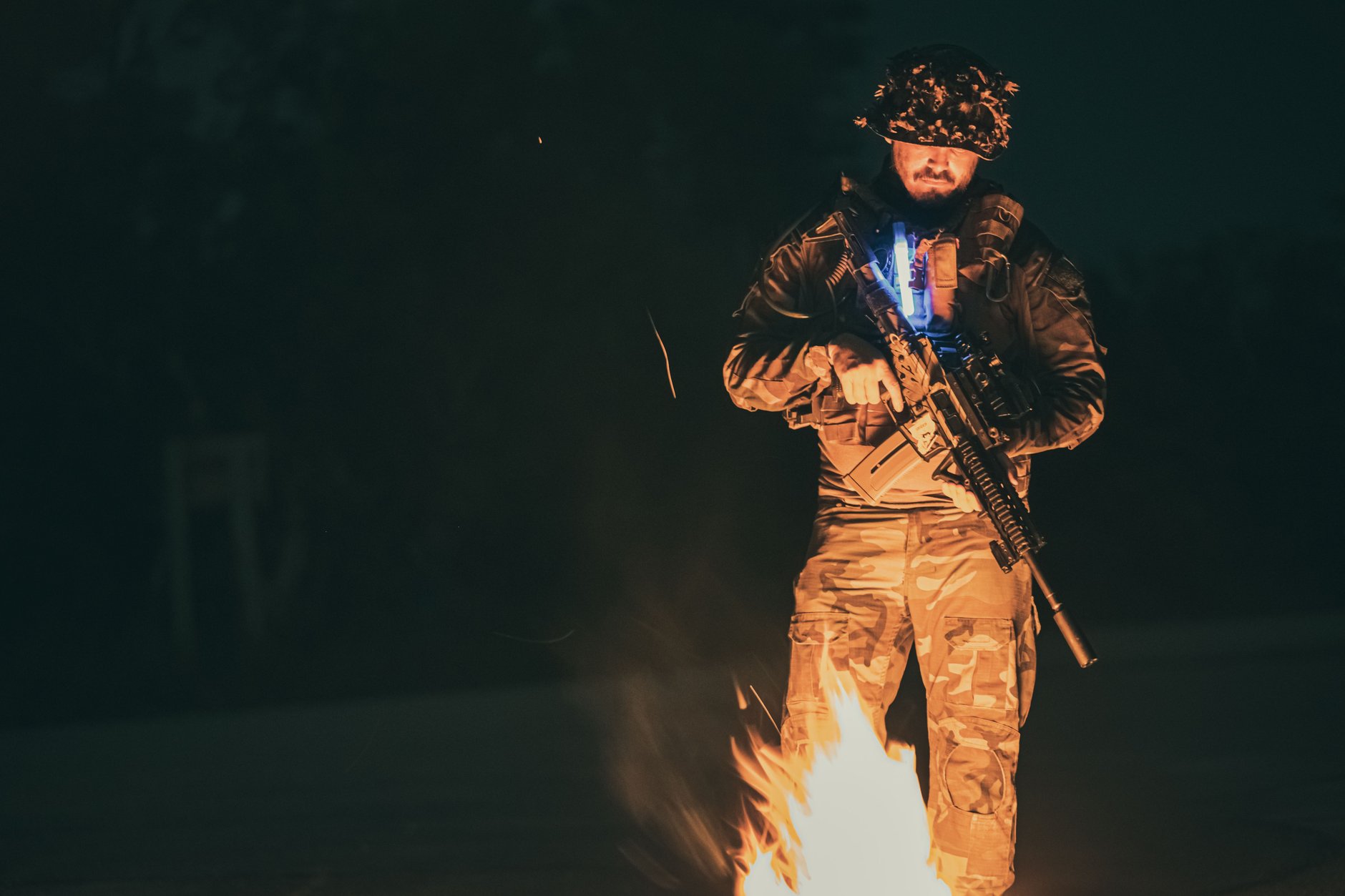
Because the sensors ride on the helmet, both hands stay free and the picture follows the wearer’s gaze; because both channels are passive, the patrol emits nothing. Total helmet-side weight matters at four in the morning, which is why the thermal channel uses an ultra-compact 384×288 core and the whole dual-channel unit stays within a few hundred grams — light enough that the team forgot about it by the second week, which is the real acceptance test for wearable equipment.
What the Thermal Solution Changed
- Detection of hidden personnel became routine. In the repeat of the spring exercise, the fusion-equipped team detected both concealed observers at over eighty meters; over the season, patrol after-action reports shifted from “nothing found” to logged detections at ranges the unit had never achieved.
- Hands-free changed how the team moves. With vision riding on the helmet, weapons, radios, and climbing all stopped competing with the sensor for a hand; team leads reported faster, quieter movement on approach.
- Zero signature became the default. White-light use on patrol effectively ended; the team’s night movements stopped being observable from a distance.
- One picture ended the two-monocular problem. Fused presentation removed the channel-switching cognitive load; newer team members reached effective night proficiency noticeably faster than with separate devices.
Module Selection Notes
Wearable fusion is a SWaP discipline: the thermal channel must be an ultra-compact uncooled core with low power draw, and the low-light channel must deliver a clean image under starlight without active illumination. The SPECTRA L04U 384×288 ultra-compact LWIR module is the thermal core for helmet and eyewear integration, and the Low-Light Visible/NIR Module provides the complementary low-light channel. See the smart wearable application page for helmet, eyewear, and monocular integration patterns.
Building a wearable fusion product or equipping a night team? Talk to our engineers about core selection, fusion architecture, and SWaP budgeting.