A belt conveyor is a fire triangle with moving parts. When an idler roller seizes, the belt keeps sliding across it; friction drives the contact temperature up steadily, and in a dusty environment — coal, grain, ore fines — that hot spot sits directly in fuel. A significant share of conveyor fires start exactly this way, at a roller that gave warning signs for hours before ignition.
This case describes the monitoring pattern an auto-parts plant and a bulk-material terminal both converged on: fixed thermal cameras watching the belt and roller line continuously, built around OEM thermal cores.
Project Background
This monitoring pattern was piloted almost simultaneously at two sites in 2024. The first is an auto-parts plant in Central China whose paint-shop and stamping conveyors run three shifts; the second is a bulk-material terminal on the Yangtze River moving 12 million tonnes of coal and ore a year over 9 km of belt. Both had experienced roller-seizure fires — the terminal two in one summer — and both were relying on patrol inspectors walking the gantries once or twice per shift.
Pain Points of the Traditional Approach
Two failure modes dominate conveyor heating:
- Seized or failing idler bearings. The roller stops turning or drags; the belt slides over a stationary shell and the contact zone climbs well above ambient. The heating is localized, progressive, and invisible from a walkway.
- Belt misalignment. A wandering belt rubs against the frame or a skirt plate, producing a hot streak along one edge — and, eventually, a frayed belt or a fire.
Both are temperature problems long before they are smoke problems, which is what makes them a good fit for thermal monitoring.
The Thermal Imaging Solution
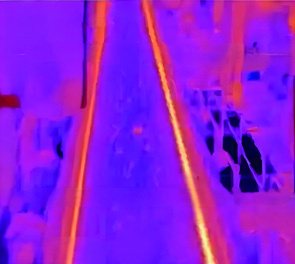
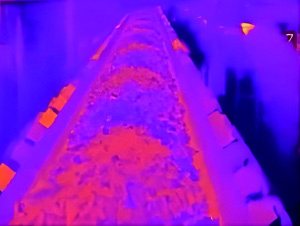
The integrator positioned fixed thermal cameras to cover the high-risk zones: the return strand where rollers are densely packed, the drive and tail pulleys, and transfer points where spillage accumulates. Each camera is built around a radiometric LWIR core that outputs temperature per pixel; the monitoring software defines measurement zones along the roller line and alarms on two conditions — absolute temperature, and temperature difference between neighboring rollers.
That second condition does most of the work. A roller running 20 °C hotter than its neighbors under the same load is a failing bearing, even when its absolute temperature is still below any generic threshold.
What the Thermal Solution Changed
- Failures caught in hours, not shifts. Seized rollers are flagged by temperature trend long before smoke or belt damage.
- Fewer walkway rounds. Maintenance now walks to the roller the system names, instead of feeling every bearing along the line.
- A fire-prevention record. Insurers and safety audits get continuous logged data rather than a paper checklist.
Module Selection Notes
Conveyor monitoring is a volume application: many cameras, modest per-camera requirements, outdoor or dusty enclosures. A 640×512 radiometric core such as the SPECTRA L06A covers most belt widths at practical mounting distances; long galleries benefit from the narrower FOV of a telephoto lens option. For high-temperature processes feeding the line, a cooled MWIR core like the SPECTRA M06A extends the measurement range. See also the fire detection application page.
Specifying thermal monitoring for conveyors or material handling? Talk to our engineers about coverage planning and core selection.