Every fast-charging session is a sustained high-current stress test. Push 250 amps through a connector for forty minutes and physics starts keeping score: a slightly loose terminal becomes a warm terminal, then a hot one, then a melted one. Charging cabinets full of busbar joints and contactors age the same way. None of this is exotic — it is the oldest failure mode in electrical work, resistive heating at a degrading connection — but a charging network multiplies it across thousands of connectors that nobody is standing next to.
This case looks at how a charging network operator put radiometric thermal eyes inside its cabinets and over its stalls, turning the oldest failure mode in the book into a trend line that arrives weeks early.
Project Background
In 2025, a charging network operator in south China — about 120 fast-charging stations, a mix of 480 kW liquid-cooled and older 120 kW air-cooled units — had its wake-up call. A connector at a highway service-area station overheated during a session and partially melted; the vehicle was unharmed and nobody was hurt, but photographs travelled on social media faster than the incident report travelled internally. The post-incident review found the familiar anatomy: the terminal had been loosening for months, and the operator’s only thermal instrument was a quarterly handheld inspection — a snapshot, four times a year, of a failure mode that develops on its own schedule. The company approved a fixed thermal monitoring program: radiometric cameras inside the charging cabinets watching terminals and busbars, and site-level thermal units overseeing the stalls during sessions.
Pain Points of the Traditional Approach
- Quarterly snapshots against a continuous failure mode. A handheld inspection four times a year samples a degradation process that runs every day; anything that starts the week after a visit has three free months to develop.
- Unmanned sites have no senses between visits. A busy highway station at 2 a.m. has hundreds of amps flowing and no one within fifty kilometres who would notice a smell, a discoloration or a wisp of smoke.
- The vehicle side was a black box. When a vehicle’s charge port or pack ran hot during a session, the operator had no data of its own — and warranty disputes with vehicle makers defaulted to the other side’s telemetry.
- Failures surfaced as damage. Connector and joint problems were discovered at the melted-plastic stage, with the station offline, the photographs taken, and the repair priced at emergency rates.
The Thermal Imaging Solution
The program deployed two tiers. Inside each charging cabinet, a compact radiometric thermal camera watches the high-current anatomy — cable terminals, busbar joints, contactor faces — continuously. Every point is trended against its own history and against its neighbours: a joint drifting a few degrees warmer than its twins under the same load is flagged for inspection long before it is hot enough to damage anything, and the alert names the component, not just the cabinet.
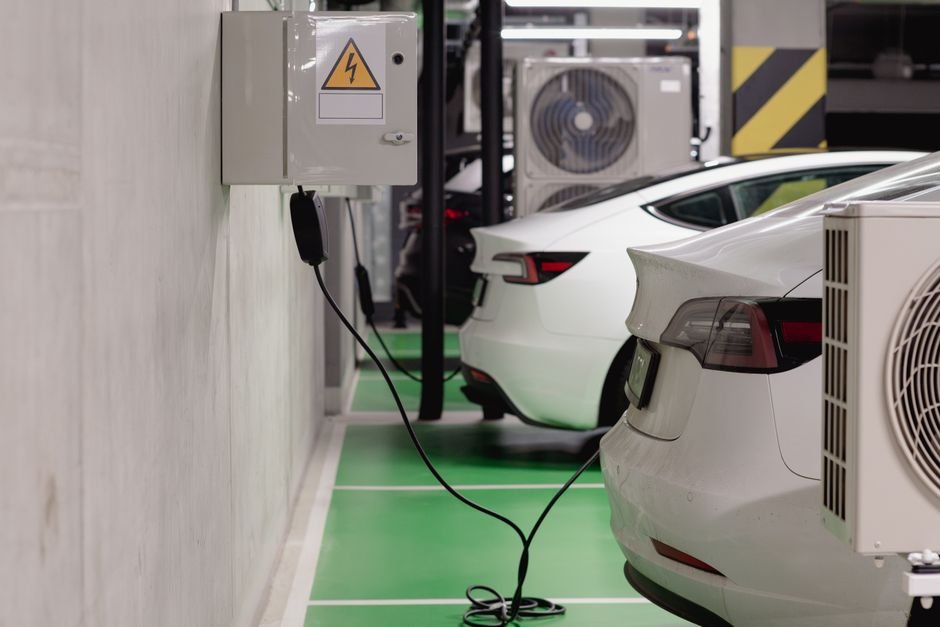
At the site level, a high-resolution radiometric unit oversees the stalls during sessions, reading the charge port area and cable of every vehicle being charged. A connector heating abnormally at the vehicle interface, or a vehicle-side pack region climbing outside its normal envelope, triggers a controlled session stop and an alert — with the full thermal record attached to the session log. The warranty conversation with vehicle manufacturers changed character overnight: the operator now brings its own per-session temperature evidence to the table.
What the Thermal Solution Changed
- Failures arrive as trends, not damage. In the first year, fourteen degrading terminals and joints were replaced on schedule as rising temperature trends — none reached the melted stage, none took a station offline unplanned.
- Vehicle-side events now have witnesses. Abnormal heating at charge ports was detected and sessions stopped in five cases; each came with a complete thermal record that resolved liability in weeks instead of quarters.
- Inspection effort shifted from sampling to verification. The quarterly handheld route now confirms what continuous monitoring already knows — technicians arrive at the flagged joint, not at every cabinet on the map.
- The network’s risk story changed. Insurers and site hosts now see per-station thermal surveillance in the safety case; the social-media incident became the reference for what the system exists to prevent.
Module Selection Notes
In-cabinet monitoring needs a compact radiometric core with good sensitivity at close focus — a two-degree drift on a small terminal is the whole signal — and a digital interface the station controller can poll around the clock. The SPECTRA L06A 640×512 LWIR module is the high-sensitivity compact core for inside the cabinet. For site-level coverage of multiple stalls from one position, the SPECTRA L12T 1280×1024 radiometric module holds detail across the whole bay. See the battery safety application page for charging and storage monitoring patterns.
Running charging infrastructure or battery assets? Talk to our engineers about thermal monitoring architecture.