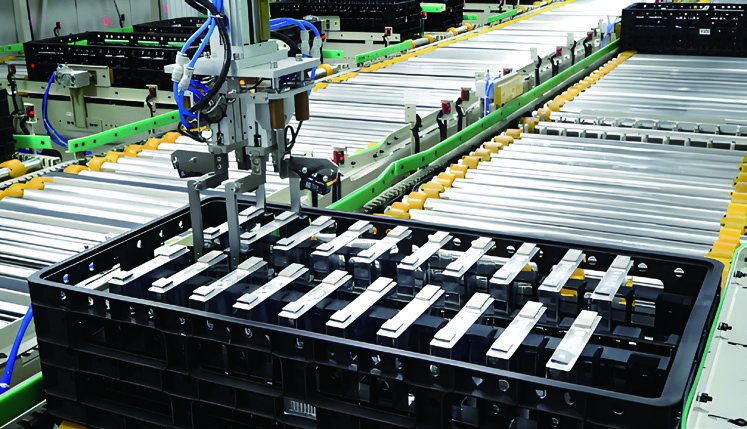
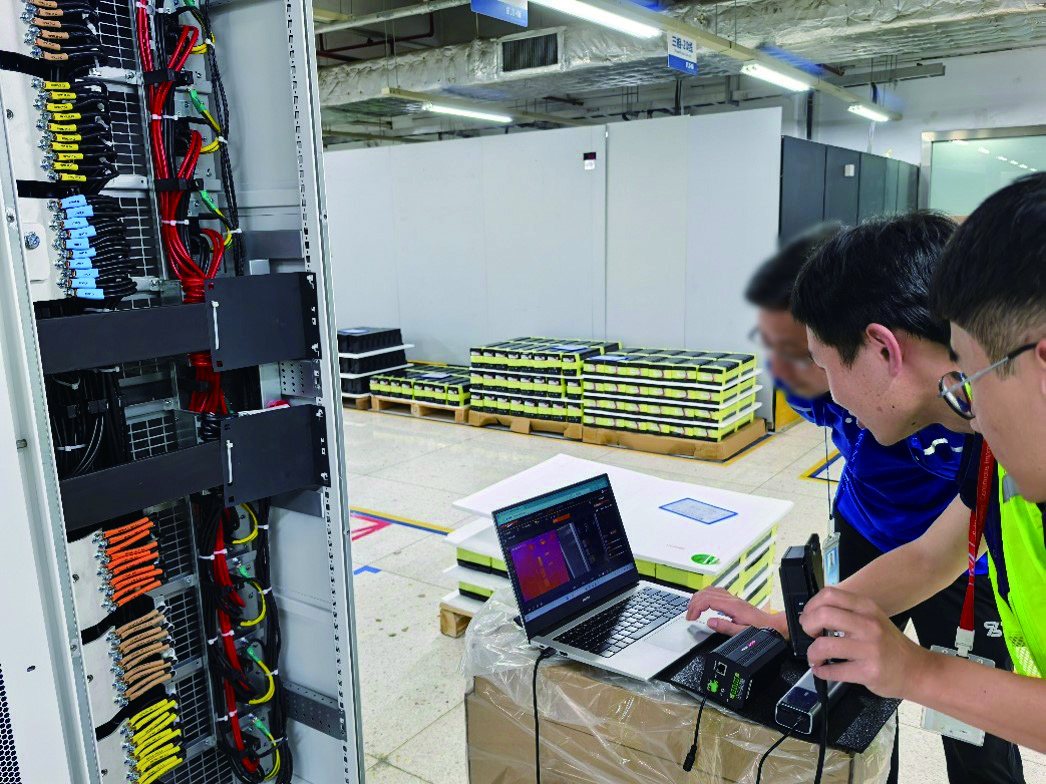
Formation and grading is where a battery cell earns its capacity rating: hours of precisely metered charge and discharge across thousands of channels. It is also where latent failures are born. Cells that run hot during formation carry that damage into the field as elevated self-discharge and early capacity fade — and the formation equipment’s own data often shows nothing wrong.
This case looks at how a power-battery plant added radiometric thermal monitoring above its formation cabinets, and what changed when temperature became a per-cell measurement instead of a cabinet-level guess.
Project Background
In 2023, a power-battery manufacturer in Central China commissioned a new formation workshop for prismatic cells: twelve lines, forty formation cabinets per line, 128 channels per cabinet — more than 60,000 cells in process at any moment. The plant had just absorbed an expensive lesson. A batch shipped to a pack customer showed elevated self-discharge in the field, and the root-cause analysis traced it to a formation cabinet whose cooling had partially failed over a weekend. The cabinet’s electrical data looked perfectly normal — current and voltage within limits on every channel — but the cells had formed 8–10°C hotter than specification. The quality department piloted overhead thermal cameras on two lines.
Pain Points of the Traditional Approach
- Channel data cannot see cell temperature. Formation equipment measures current and voltage with excellent precision, but temperature comes from a few cabinet probes — an average over a volume, not a measurement of any cell.
- Cooling failures are electrically silent. A clogged filter or a failed fan appears nowhere in the electrical record until the cells are already ruined.
- Sampling QC is late and destructive. Teardowns and OCV tracking catch problems days later, after thousands more cells have passed through the same cabinet.
- The economics are brutal. One missed cabinet fault is a full batch of suspect cells — a five-figure direct loss plus the harder cost of a pack customer’s trust.
The Thermal Imaging Solution
The pilot mounted radiometric LWIR cameras above the formation cabinet rows, sighted down onto the open cell trays during charge and discharge steps. Each camera covers a bank of cabinets, and its 640×512 radiometric array puts several pixels on every cell surface — enough to resolve a single hot cell or a warming tray corner.
The analytics work on two levels. At the cell level, any cell running more than 2°C above its tray median during a given step is flagged and its channel position recorded; at the cabinet level, a rising spatial gradient across a cabinet indicates cooling trouble long before the average temperature moves. Flagged positions are written to the MES automatically, and those cells are physically quarantined at discharge — no flagged cell leaves the workshop in a shipment batch.
What the Thermal Solution Changed
- Cooling failures surface in minutes. A cabinet gradient alarm now replaces the weekend-surprise scenario; maintenance gets a work order while the batch is still saveable.
- Hot cells are quarantined at the source. Field self-discharge claims on the pilot lines dropped measurably, and batch-level recalls gave way to per-cell rejection.
- Customer conversations changed. Thermal maps now go into 8D reports to pack customers — objective, timestamped evidence instead of assurances.
- Recipes improved. Step-current profiles were adjusted where thermal maps showed end-of-charge heating clustering, tightening the process window for every subsequent batch.
Module Selection Notes
Formation-line monitoring needs a radiometric LWIR core with per-cell pixel density at gantry height, a frame rate quick enough to follow charge steps, and GigE connectivity for the MES network. The SPECTRA L06A 640×512 LWIR 12μm core is the natural fit; where one camera must cover denser cabinet banks, the 1280×1024 SPECTRA L12NT steps up the pixel budget. See the process monitoring and battery safety application pages for related patterns.
Instrumenting a formation workshop or a battery production line? Talk to our engineers about core selection, optics, and MES integration.