Underground cable tunnels are everything people dislike about inspection routes: long, narrow, humid, poorly lit, and full of energized high-voltage joints you would rather not stand next to. Yet the joints and terminations in those tunnels are exactly where thermal anomalies announce themselves first — a warming cable joint is the earliest, cheapest warning a grid operator can get.
This case covers a utility that moved tunnel patrols from a two-person walking crew to a rail-guided inspection robot carrying a thermal camera built around an OEM core.
Project Background
In 2023, a provincial grid utility in East China took stock of its urban cable network: 38 km of 110 kV and 220 kV tunnels under the city center, patrolled by two-person walking crews. A full route took a crew three days, covered every joint and termination visually and with a handheld camera, and was repeated monthly — a cadence the utility’s safety office already considered too slow for the oldest sections. The utility piloted a rail-guided inspection robot on the oldest 4.5 km loop.
Pain Points of the Traditional Approach
The walking patrol had the usual arithmetic working against it. The tunnel ran several kilometers; a thorough thermal pass on foot took most of a day, so it happened monthly at best. The environment fought back too: in a dark tunnel, a handheld camera’s image depends entirely on the operator’s aim and steadiness, and the written log captured a handful of spot readings per joint rather than the joint’s full thermal picture.
Most importantly, the interval was wrong. Cable joints that begin to degrade can cross from “warm” to “failed” in less than a monthly cycle — the patrol schedule, not the equipment, had become the weak link.
The Thermal Imaging Solution
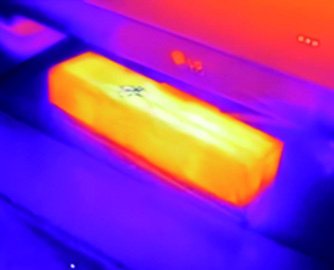
The robot builder integrated a compact thermal module — a radiometric LWIR core with a matching visible camera — onto a pan-tilt head on a rail-guided chassis. On each run, the robot stops at programmed positions opposite every joint bay, pans to each termination, and records both thermal and visible frames with position metadata. Radiometric data streams back to the control center over the tunnel’s fiber network.
Because the stops and angles are programmed, every joint is imaged from the same position every run. That repeatability is the quiet superpower of the system: the monitoring software can compare today’s joint against the same joint last week, pixel for pixel, and flag drift that no single image would reveal.
What the Thermal Solution Changed
- From monthly to daily. The tunnel now gets a full thermal pass on a scheduled run — or on demand after a grid event.
- Comparable data. Fixed viewpoints make trend analysis meaningful; alarms are based on change, not just thresholds.
- People out of the tunnel. Crews enter for maintenance, not for measurement — a safety improvement as much as an efficiency one.
Module Selection Notes
Robot payloads are SWaP-constrained: the core must be small, light, low-power, and happy on a moving platform. The SPECTRA L06A 640×512 LWIR core is the workhorse choice for joint and termination inspection; dual-band designs like the FUSION LV0625A combine thermal and visible channels in one payload. See the mobile robot application page for more integration patterns.
Building a thermal payload for an inspection robot? Talk to our engineers about cores, interfaces, and payload-level integration support.